
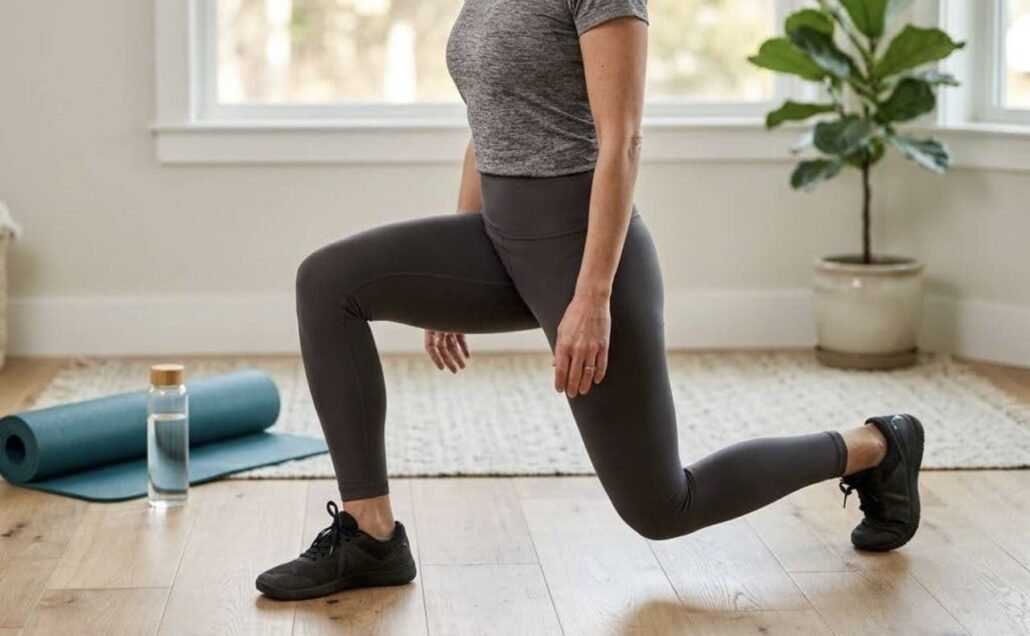
Sharp Pain in Thigh When Doing Lunges: Why Form Fixes May Not Be Enough
Sharp pain in the thigh during lunges is not simply a sign of tightness or poor form. It often reflects a deeper pattern involving muscle imbalance, hip instability, or knee tracking problems that stretching and technique cues alone will not address. A physiotherapy assessment looks at how your hip, knee, thigh, and trunk work together so you can identify the real contributing factor and move forward with a plan that fits your body.
You start a lunge and the first few feel fine. Then, somewhere in the descent, a sharp sensation grabs the front of your thigh and makes you stop mid-movement. You wonder if you went too deep, if your hip flexors are too tight, or if you are simply not ready for this exercise yet.
This experience is more common than most people realize, and it does not automatically mean you are pushing too hard or lacking flexibility. Sharp pain in the thigh when doing lunges is a signal worth paying attention to, not something to push through or fix with a quick stretch before the next set.
This post will help you understand what that pain may be telling you, why form corrections alone often fall short, and how a physiotherapy assessment can identify the movement patterns contributing to the problem so you can get back to training with more confidence.
Why Sharp Thigh Pain During Lunges Is Easy to Misread
The most common assumption is that thigh pain during lunges points to tight hip flexors, stiff quads, or not warming up properly. It is a reasonable first instinct, but tightness is only one piece of a more complex picture.
There is an important difference between the muscle fatigue that comes from working hard and the sharp, specific pain that appears during a particular movement. General fatigue tends to feel diffuse and builds gradually. Sharp pain tends to arrive at a predictable moment, often in the front or upper thigh, and it does not fade when you push through.
Lunge pain in the front of the thigh can involve several structures. The quadriceps muscle group, which runs along the front of the thigh, works hard to control the descent and drive the return. The hip flexors attach across the front of the hip and upper thigh and are active throughout the movement. The patellofemoral joint, where the kneecap meets the thigh bone, also comes under significant load during lunges. According to the Mayo Clinic, patellofemoral pain is often aggravated by activities that load the knee in a bent position, including lunges and squats.
If you find yourself asking “why do my thighs hurt when I lunge?”, the answer may involve any one of these structures or a combination of how they are sharing load during the movement. When pain changes your confidence, reduces your depth, or makes you hesitant to put weight through that leg, it deserves proper attention rather than a stretched warm-up and a hope it settles.
What Your Body May Be Communicating During a Painful Lunge
Sometimes the pain itself is only part of the picture. Pay attention to what else is happening during the movement: your knee drifting inward, your hip dropping to one side, a sense of imbalance, or noticing the pain only on one side.
These patterns often point toward muscle imbalance causing thigh pain. During a lunge, the glutes, quadriceps, hip stabilizers, and trunk all need to coordinate together. When some muscles are not contributing enough, others compensate by working harder than they should. The front of the thigh, in particular, can end up absorbing load it was not designed to carry alone.
Hip Instability and What It Means in Practice
Hip instability in this context means the hip is not controlling the position of the thigh bone well enough as you lower and rise. The femur, the long bone of the upper leg, needs to stay aligned throughout the movement. When the muscles around the hip are not strong or coordinated enough to maintain that position, the thigh rotates or shifts in ways that place extra stress on the front of the thigh and knee.
Knee Tracking and the Patellofemoral Connection
Knee tracking refers to how the kneecap moves along the groove at the front of the thigh bone during bending and straightening. Physiopedia notes that abnormal tracking often relates to hip muscle weakness, foot position, and movement control rather than the knee itself. When the knee collapses inward or shifts forward without adequate control, the kneecap experiences uneven pressure, and sharp thigh pain during lunges can result.
None of this implies a specific diagnosis. It is a way of understanding that sharp thigh pain during lunges is frequently a movement coordination issue, not simply a flexibility problem.
Why Adjusting Your Form Often Is Not Enough
Coaching cues like “keep your knee over your toes” or “don’t let your knee cave in” are genuinely useful. But a cue tells you what to do, not whether your body currently has the strength, mobility, and timing to do it consistently under load.
A person can understand correct lunge mechanics perfectly and still not have the capacity to maintain them when fatigued, when the weight increases, or when the movement gets faster. Research published through the National Institutes of Health highlights the role of hip abductor and external rotator strength in controlling lower limb mechanics during functional movements, which directly affects how the knee and thigh behave during exercises like lunges.
Other factors play a role as well. Previous sprains or strains, prolonged periods of sedentary work, accumulated training load, or age-related changes in muscle strength all affect how the body manages the demands of a lunge. For healthcare workers, teachers, and others on their feet for long hours, fatigue already accumulated in the hip and thigh muscles before training even starts.
The goal is not to achieve a textbook lunge. It is to find a version of the movement your body can tolerate right now, while gradually rebuilding the strength and control needed to progress.
When Should You Stop, Modify, or Get Assessed?
Not every instance of discomfort during lunges requires you to stop training entirely, but sharp pain is a signal to change something.
Consider stopping or reducing the movement when:
- The pain is sharp and arrives consistently at a specific point in the movement
- Pain worsens with each repetition rather than settling
- Your leg feels unstable or weak afterward
- You notice swelling or the pain lingers into daily activities like walking or using stairs
Modifications worth trying include reducing your depth, slowing the tempo, using a wall or chair for balance support, switching to a stationary split squat, or temporarily choosing a different lower-body exercise while you address the underlying issue.
Consider a physiotherapy assessment if:
- Pain keeps returning whenever you reintroduce lunges
- It is one-sided and affecting how you move throughout the day
- You have tried modifying and the problem persists
If you experience sudden severe pain, significant swelling, inability to bear weight, numbness, or a traumatic injury, seek assessment from an appropriate healthcare provider promptly.
How Physiotherapy Looks Beyond the Lunge Itself
A physiotherapy assessment for lunge-related thigh pain goes well beyond watching you perform a lunge. It looks at the full system involved: hip strength, quadriceps and hamstring capacity, ankle mobility, single-leg balance, trunk position, and how your knee tracks through the movement.
Your physiotherapist will often compare both sides, assess related movements like squats, step-downs, and stair climbing, and observe how symptoms behave across different tasks. This broader picture helps identify where the movement system is not sharing load efficiently.
The individualized treatment plan that follows may include strength work targeting the hip stabilizers and glutes, movement retraining to address coordination and control, mobility work where stiffness is contributing, and a structured return to lunges at the right pace for your current capacity.
Hands-on treatment can help reduce symptoms or address mobility restrictions, but it works alongside active rehabilitation when movement control is part of the issue. If hip instability and knee tracking during lunges are contributing factors, passive treatment alone is unlikely to resolve the pattern long-term.
Our physiotherapy team brings this kind of thorough assessment approach to every patient, because the same symptom can have very different origins depending on the person.
Rebuilding Confidence With Lunges Over Time
Recovery from lunge-related thigh pain is a process, not a single correction. A general progression moves through a few phases: settling the irritation, identifying the movement limitation, rebuilding strength and control in lower-load positions, and then gradually reintroducing lunge depth, speed, and load.
The timeline and the path look different depending on who you are. A high school athlete, a weekend warrior returning after a break, a nurse managing cumulative lower limb fatigue, or an older adult rebuilding leg strength each bring a different starting point and different goals.
| Patient Profile | Common Contributing Factor | Typical Progression Priority |
| Weekend warrior | Load management, infrequent training | Gradual load increase, consistency |
| Healthcare worker or teacher | Cumulative fatigue, prolonged standing | Hip strength, fatigue tolerance |
| High school or recreational athlete | Rapid load increase, growth-related changes | Movement control, progressive loading |
| Older adult | Strength reduction, balance changes | Single-leg stability, supported movement |
For some people, returning to a full lunge is the goal. For others, a well-loaded split squat or step-up builds the same capacity with less irritation, and that is a completely valid outcome. The aim is to help you move with more confidence, not to push you toward a specific exercise at the cost of your comfort and safety.
Key Takeaways
- Sharp pain in the thigh during lunges is distinct from general muscle fatigue and should not be pushed through without understanding the cause.
- Muscle imbalance, hip instability, and poor knee tracking are common contributing factors that stretching and form cues alone do not address.
- The patellofemoral joint and the structures around it come under significant load during lunges, and abnormal knee tracking often relates to hip muscle weakness rather than a knee problem.
- Modifications like reducing depth, slowing tempo, or switching to a split squat can allow continued training while you address the underlying pattern.
- A physiotherapy assessment evaluates the full movement system including hip strength, ankle mobility, single-leg control, and trunk position to identify the actual source of the problem.
- Recovery follows a progressive path, and the right progression depends on your age, activity level, work demands, and specific movement limitations.
Ready to Understand What Your Thigh Pain Is Telling You?
If sharp thigh pain during lunges keeps returning, stretching more and adjusting your form may not be enough to resolve it. The pattern often runs deeper than the lunge itself.
At Treloar Physiotherapy in Vancouver, our physiotherapists assess how your hip, knee, thigh, and movement patterns work together. We have been supporting people in this community since 1982, and our team brings both clinical depth and a genuine interest in your specific goals and current capacity. From weekend warriors to healthcare workers to older adults rebuilding strength, we build individualized plans that meet you where you are.
Book an assessment to get a clearer picture of what is contributing to your pain and what a practical path forward looks like for you.
Frequently Asked Questions
Should I keep doing lunges if I feel sharp pain in my thigh?
Sharp pain is a signal to stop or modify the movement rather than continue. Pushing through sharp, consistent pain during a specific exercise often aggravates the problem rather than resolving it. If the pain keeps returning, worsens over time, or starts affecting your walking or daily activities, a physiotherapy assessment is a worthwhile next step.
Is sharp thigh pain during lunges caused by tight hip flexors?
Hip flexor or quadriceps tension can contribute, but tightness is only one possibility. Strength imbalance around the hip and glutes, knee tracking problems, patellofemoral joint stress, tendon irritation, and load tolerance can all produce similar symptoms. Treating tightness alone may not address the full picture.
Can physiotherapy help if my lunge form already looks correct?
A lunge can appear well-aligned from the outside while the hip, knee, or thigh muscles are still not sharing load efficiently. A physiotherapy assessment goes beyond visual form to evaluate strength, coordination, mobility, and symptom behaviour across multiple movements. This gives a more complete and individualized picture of what is contributing to the pain and what needs to change.
